

Dagen Walton on Rods, Reels, Lines and Swinging Flies in Bristol Bay
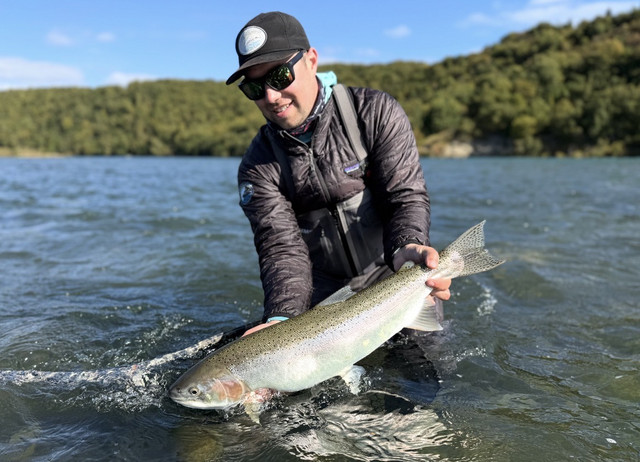
About Dagen Walton
Dagen Walton guides on the Kvichak and Naknek rivers for his family's Last Cast Lodge in Bristol Bay, where I stayed on my first trip to the region. This episode is a deep dive into the gear: which rods, reels and lines he fishes and why, fluoro-coated leaders, getting flies down with line management instead of weight, bright flies on bright days, and why he tells friends to buy a good reel before an expensive rod.
5 Key Moments
1. Buy the reel before the rod
Dagen fishes a 10-foot six-weight G. Loomis NRX Plus. He admits he once dismissed G. Loomis because they also make bass rods. But his advice to friends is to spend on the reel first, and one of his favorite rods is still the cheap Fenwick he bought at Sportsman's Warehouse. I've heard it the other way, too, but on salmon and steelhead a gummed-up reel ends the conversation.
“"All rods are going to bend. Get a decent reel, because your drag will actually affect you catching fish more than the rod will."
2. The marriage of line and rod
When I asked what people overthink, Dagen said he overthinks fly line himself, especially two-hand shooting heads. He thinks it's worth it. He spends a lot of $45 trial-and-error experiments chasing the right match, because the line decides how any rod casts.
“"You could have a cheap rod and a very good line, and if the marriage is good, that rod's going to feel like a thousand-dollar rod."
3. Fish a confidence fly
Dagen fishes bright flies on bright days, and his dad swears by the opposite. I like pinks, and other anglers fish nothing but purple and black. Everyone catches fish. His point is that confidence changes how you fish. You let the fly hang at the bottom of the swing instead of recasting too soon.
“"A lot of your bites come at the bottom of your swing when you're just kind of standing there doing nothing."
Transcript
Lund: So let's deep dive in. Let's start with the rod. What type of rods do you have, and why? At this point you've been able to cast some rods and fish with some rods, and you've made the decision to have the rods you have. What and why?
Walton: My rods all have different purposes, or a different mode in which I fish. When I'm fishing out of a boat, I prefer a single-hand rod over a switch rod for fishing an indicator rig. It's just a little lighter in hand. But I do prefer a 10-foot over a nine-foot rod.
Lund: Are we talking about a boat in Bristol Bay, or a drift boat somewhere else? What's the boat situation when drifting?
Walton: Whether you're getting rowed somewhere, which we'll do on a versatile day on the Kvichak or the Naknek when you're bead fishing primarily, or sometimes dead-drifting flesh, and doing it under an indicator. I do prefer a single-hand over a switch rod. Switch rods are great, and they can be great for indicator fishing as well, but I like the lightweight single-hand. When swinging flies, I'll always have a switch rod and a spey rod in the boat, whether I'm fishing for myself or guiding. I'm fishing them the exact same way, but I'll make sure there are some differences between the two, maybe sink tips or line density. If it's windy, it'll be a little harder to cast the switch rod, so I'll switch to the spey rod. It has a little more backbone and a little more power, so you can punch through the wind or fight it a little better. The rods I own now have made me a versatile angler who can fish different ways depending on the situation.
Lund: What is it about those rods? Do you like a medium-fast action, a fast action? What do you have for the single-hand?
Walton: I fish a 10-foot NRX Plus, which is a G. Loomis rod. It's a six-weight, and it's got just enough backbone. I feel comfortable landing any fish, especially out of a boat when you're drifting with that fish. This is totally ridiculous, but because G. Loomis also makes gear rods, conventional rods and bass rods, I thought, well, they can't be a real fly rod company. If you do everything, you might not be a specialty brand. So when I was first starting off, I had a chance at a lower-end Sage, and I went with that because I thought Sage had to be the fly fishing experts. That was a great call. But then I realized G. Loomis makes an exceptional rod, and just because they don't specialize in one method doesn't mean they're not good. This is the first G. Loomis I've owned. It is kind of confusing, because this is the NRX and their gear rods have similar acronyms with an X at the end. If someone tells you in passing what they're fishing, you might not even know whether it's a fly rod or a gear rod. But they make great sticks. I really enjoy that rod.
Every top rod company has the equivalent of that rod, and they compete head to head really well. The Sage R8, or previously the Sage X, will compete with the NRX Plus in the same weight and length. You might find some subtle differences. But when friends come to me asking what they should spend money on, I always tell them, don't worry about a nice rod. Get a decent reel, because your drag will actually affect you catching fish more than the rod will. Once you get deeper into the sport and can tell some of those subtleties apart, you may find more enjoyment in a more expensive rod. But one of my favorite rods to this day is the first rod I ever bought, and it's still a rod I use regularly. It's a cheap Sportsman's Warehouse Fenwick that I just love.
Lund: See, I've heard both of those things. I've heard spend the money on a rod, because you're going to be casting a lot, and if you're casting all day, you're going to enjoy the experience. If the rod can do what you need it to do, the different types of casts, you're not going to get frustrated. So spend the money on the rod, and as long as you have a baseline capable reel, you'll be fine. I've found that makes a lot of sense when you're presenting flies to creek trout or smaller river trout. But as you get into larger fish, salmon, steelhead, all it takes is a cheaper reel to gum up, or even if it's a little heavier, the balance is a little off. So it makes sense that I've heard it the other way, too. Make sure you get a good reel first and a capable fly rod you can cast well.
Walton: I'd agree with that. The reel is so important, regardless of what species you're targeting. Even with smaller fish in streams and little creeks, if you have your drag set correctly for that fish, I think you'll produce more fish than with an expensive rod and a dinky reel. I stand by that. It's always the advice I give my friends, because all rods are going to bend. If you get something middle-of-the-road, or even slightly less than that, it's going to be a pretty capable rod, and it'll be affordable.
As far as reels go, I have a Nautilus, and I love it. I have various reels, though. I have some Nautiluses. I have some Taylor reels, which is a direct-to-consumer company. They make some fun reels, and they look cool. I have a Saracione, which is a click-and-pawl, two-hand-specific reel, very heavy. It was actually given to me as a tip, so anytime I use it, it brings back good memories. Those click-and-pawl reels are kind of a nostalgic thing for steelhead fishermen. It's a niche within the fly fishing community, but they're fun to fish and they can sound crazy. I fish a Lamson. That was the first nice fly reel I had. It was a Konic, I think, and then I got the Guru and really liked that. A couple of times I slipped and fell and smashed it on a rock, and it didn't bother it whatsoever, so I've been pretty in with them. And a buddy of mine who came up to Alaska a couple of times got me a Galvin reel, because his company supplied the material for them. That thing is awesome. It's a T7, I've had it for years and it just works. It's really scratched up, but man, the Galvin is such a great reel.
Lund: I think you'd find the Galvin would be quite comparable to the Nautilus. The times I've handled Galvins from clients or friends, they feel quite similar and sound pretty similar, that soft click in and out. Once you get into the sport more, you'll find your own taste and preferences, whether that's a faster or slower action rod, or a quiet reel or a loud reel. Those are subtleties that a lot of times won't change your catch rate, but they'll change the way things operate and affect your enjoyment. My first reel was a Lamson Guru, and I still have it. I love it. I think Lamson is probably the most reel you can get for your money. I also have an Abel I love and fish a lot. What about spools? Do you ever swap out spools, or do you swap out whole reels?
Walton: As I've gotten further into the sport, now I'm swapping reels, and I'm fortunate to be in a position to do that. But earlier, when I was getting into it, I definitely had a couple of spools. You get the same effect with multiple spools as with multiple reels when you're fishing one rod and switching lines, if that's all you need to do. But now I never go on the boat with fewer than three rods, and a lot of times I have five, so you need those extra reels. But having an extra spool is super effective, and I fished that way for quite some time.
Lund: What about arbor size? Do you get into the large-arbor ones? Are you worried a whole lot about retrieval, or is it mostly about pairing something nice and balanced?
Walton: The answer is yes. It depends. With these two-hand systems, I'm not super worried about the arbor so much as the weight of the reel. The Saracione I have has a really small arbor, but it's a very dense reel, and it provides a lot of good balance when you're fishing those longer rods. I've done a little saltwater fly fishing, and in salt I do feel like a lightweight large-arbor reel is advantageous. In the middle of that, fishing trout, I think a large arbor can always help you, but I'm more worried about the balance, because it'll affect how tired I get over the course of a day, and how the rod functions. Balance has a lot of effect on your cast.
Lund: Next would be fly lines. When I started off, I was first directed to Rio, and it seems like you don't really have to go anywhere else. Rio is really good, but Scientific Anglers is also really, really good. Are there many options outside of Rio or Scientific Anglers?
Walton: Funny enough, I was just texting with a client today, and he put me onto a new brand of lines, Bridge Lines, and they're two-hand specific. There are a lot more options out there than I think we realize, because you get put onto Rio and it's like that's all you really need. Some of these two-hand line companies only do one mode. They don't have your traditional weight-forward single-hand lines. Companies like Rio, Scientific Anglers and Orvis cover the wide spectrum for the average angler. Preference-wise, I've used them all, and I've honed in on Scientific Anglers. I feel like their durability is better over time. I also like that they've incorporated overlining into their lines, which makes casting and loading your rod a little easier, with a little less effort. The line does a little more of it for you. Rio started to do that as well, and other line companies too.
Lund: I think a line that's built overweighted is better than buying a line a full class heavier, because of the science that goes into it. They'll say it's half a weight heavy or one line size heavy, and even then, their science is going to be more honed in on what it should be for overlining. You might truly overline your rod if you go up a weight on your own without doing your homework. I've used some Airflow tips, but most of the fly shops I go into are fairly small, so they can't carry five different brands. You go with the recognizable ones. Have you used Airflow at all? Are you familiar with their stuff?
Walton: I don't have a whole lot of their single-hand stuff, but a lot of our client rods have Airflow lines on them. They're super durable lines, which is really nice. One nice thing about Airflow in Alaska is that they don't deteriorate from bug dope. DEET and bug dope will eat the coating of most other fly lines, but Airflow, I think because they're PVC-free, won't melt under the bug dope. Not that you can watch it melt in your hand, but over time, if you're handling it, it will eat the coating away on your traditional Rio and Scientific Anglers lines.
Lund: The water up there is fairly chilly. Would you look for an all-around line, or are certain lines less susceptible to water temperature?
Walton: The all-around lines will handle cold water temps just fine, unless you're fishing something truly cold. I don't see cold-water-specific lines very much. The normal line will handle cold water. Then obviously when you go into the tropics, you get into your warm-water lines that can handle the heat, so they won't gum up in your guides when you're casting and the coating won't get soft and gummy.
Lund: That's one thing I liked about the Rio box. You can look at the box and think, okay, this has a redfish on it, or a tarpon. That's at least a starting point when you're looking at the species and trying to match it, and generally it's pretty accurate. I've seen a couple of people use the Outbound Short, and people talk about it. It's a shooting line from Rio, and a lot of stuff is advertised as the next best thing. Sometimes it ends up being a good thing. Other times it's kind of specific but not really worth it. Have you used the Outbound Short at all?
Walton: I have an Outbound Short that I haven't lined on a reel yet. The one I have is a fully integrated line with a sinking tip at the front. Thinking about it, and casting other lines that are similar, it's going to be a little heavier casting long distances. But at 30 to 40 feet, you'll be able to get it there in one false cast. It's just going to want to fly. If you're trying to carry really long distances, you're going to need a very fast action rod to generate the line speed to keep proper loops in the air.
Lund: I think they're going to cast really well, because it's going to act almost like a single-hand shooting line. One false cast, two at most, and you'll be able to really push it out there. I have that on a Lamson reel, and I got a Sage R8, and I was casting from my skiff to king salmon. It was pretty crazy. People talk about the shooting head, and the picture on the front is some guy absolutely bombing out a cast. Okay, whatever, advertising. But I really felt like I had to hold on to the line and be very careful, because it was just flying out. So I was super pleased with that. But like you said, with the fast action, you've got to be aware of things. I'm not a great caster, but pairing that line with a good fast-action rod is definitely the way to go. I'm excited to use it a whole bunch more.
Walton: I'm excited to load mine up. I bought that line for my 10-foot six-weight G. Loomis. There are a couple of variations of the Outbound Short, and there's another one I'd like to get that isn't a full intermediate sinking running line. It's floating, with a section of sink. I think it'd be a little easier to cast long distances, but it would still have that principle of making a run-of-the-mill cast. You're fishing out of a drift boat and you just need to cast 30 to 40 feet. One false cast, you're there, and you get to fishing as quick as you can rather than spending time casting.
Lund: What would you recommend if someone was going to come fish where you are? If someone's coming up to fish the Kasilof or the Kenai, what would you recommend line-wise versus Bristol Bay? Or are they the same thing?
Walton: Fairly similar. On the Kasilof you've got a lot of rocks and boulders, and on the Kenai you've got a lot of rocks and log sweepers, a lot of trees around the perimeter of the river. So depending on the section you're fishing, it could be the same as what I'd recommend on the Kvichak, or it could vary depending on the run or the slots or the features in front of you. But a lot of the time you can get the job done with what you have through proper manipulation of your line. If you go in knowing the mode you're going to fish, you'll find a way around the features and fish them in an advantageous way.
Lund: Do you think people overthink the fly rod, the reel or the line? Which one do people second-guess or overanalyze?
Walton: Myself, I overanalyze line, especially when it comes to two-hand stuff.
Lund: Is that a good thing? Sometimes you overthink something, or think a lot about it because it makes sense. Other times you really don't need to put that much time and effort into scrutinizing it. Do you think it's worth it?
Walton: I think it is. You could have a cheap rod and a very good line, and if the marriage is good, that rod's going to feel like a thousand-dollar rod if it casts straight. The line is going to determine that. So having the proper marriage of line and rod is so important. I go through a lot of trial and error with two-hand shooting heads. You read something on a forum, or a buddy tells you he just got this line, and it's like, all right, I'll spend 45, 50 bucks, whatever it is, and see what it's like in my own setup. Sometimes it works, sometimes it doesn't. I've had more trial and error with two-hand shooting heads than with anything else, but it's been fun to hone in on what works. Whether it's a two-hand rod or a single-hand rod, when the marriage is right, it's such an enjoyable experience to cast. It's even more fun to cast a two-hand rod than a single-hand rod when the marriage is right, because you're casting farther, and you feel good about yourself when you see a hundred-foot cast go out.
Lund: What about leaders? Rio makes the VersiLeader, and Scientific Anglers has the Absolute Salmon/Steelhead leader. What are you going for with leaders?
Walton: When I'm fishing two-hand, I'm just using a straight stretch of leader. I don't really have to taper things down at all. I'll show you this. I've got my box right here. In my boat box, I fish a NAM product. It's out of Sweden. It says Zenta at the top, but NAM is the company that makes it. It's a monofilament that's fluoro-coated. I used to fish straight fluorocarbon, but compare the tensile strength. This Rio, which is 1X, is 0.254 millimeters in diameter and 13.3-pound test. The NAM product is 0.33 millimeters, so only about 0.08 more, but it's rated at 26.3 pounds. So for hardly any more diameter, you're getting almost twice the tensile strength. Fishing my two-hand setups, when the strikes are really hard and you're fishing a tight-line system, I have not, knock on wood, broken off on a hook set with this, and I have with others. So I'm really impressed with this fluoro-coated monofilament.
With gear, you know what you know, and with the right mind, you're always going to learn something from someone else. One of the coolest parts about having a lodge is that our clients have been awesome. They all come in with their own background and show us something new, and it becomes my own. Jeff Kelly put me onto this, and I've fished it ever since. It's awesome.
Lund: When you need to get down a little bit, what are the depths of some of these rivers, and how do you fish those columns? If there's a section that's 10 feet or deeper, versus mid-depth, versus knee-high, how are you adjusting? How are you getting flies to those areas? Are you adding weight? Adding sink tip? Going to a heavier fly? What's your approach to varying depths?
Walton: It would depend on whether I was fishing an indicator rig on a single-hand rod or swinging flies on a two-hand setup, though you can also swing flies on a single-hand. To keep things simple, swinging on a two-hand setup, I'd adjust my sink tip as needed. Adjusting your sink tip will get you down more, but you can fish deeper than you might think, even with lighter setups, through proper line manipulation. When you're swinging flies and you cast out and give your line a good mend, similar to what you'd do with an indicator to create that dead drift, your fly drops, because there's slack in the line. It's not taut, so it's not getting pulled up the water column. When you mend, it drops a little. It also slows your swing down, and when the swing slows, it continues to drop a little more. So I focus a lot on line management when I'm fishing something deeper. I don't always have to change my setup. I just have to change the way in which I attack it.
Sometimes that means casting a little farther upstream in a faster run. But if I'm fishing a slower run and I cast too far upstream, then before my line gets tight, the fly is dropping, dropping, dropping, and sometimes it drops too far and you snag up. So the next cast, you'd cast a little farther downstream and let the current take the line, keep things tight and not let it get all the way to the bottom. When I'm fishing an indicator setup and want to get deep, I'll typically just add split shot and raise my indicator if I need to. I try to get down to the bottom, and make sure it's on the bottom before where I expect a fish to be. I want that fish to see it coming at it from as far in front as I comfortably can, looking as natural as possible.
Lund: When you're doing the line manipulation, how important is it to stay connected? Sometimes if I get a little sloppy with the line and I'm not tight, I miss some strikes, or I don't even feel a strike. Do you just get used to manipulating the line while still being able to feel a subtle take?
Walton: When I'm fishing two-hand stuff and I cast out, I give myself a nice upstream mend, lifting all the line on the surface out of the water and placing it above where the fly is. Then I don't just immediately relax and introduce slack into the line. I keep things tight and hold my rod away from my body, and I follow the slack down. Eventually, when it gets down to the bottom and things become tight again, I can relax a little. But you definitely want to stay tight, because you could miss aggressive fish, and those are the fish you want to catch. The fish that hit mid-swing are the ones that are hot.
Lund: I've had at least a few times when I'm reaching out with the rod way above my head, because I want to keep the slack off, and then I get a strike and I don't have the same leverage, and I'm trying to either strip or set. It's fun and awkward, but it makes for a great little bit of chaos.
Walton: Absolutely. Your range of motion just isn't as much, so they'll catch you with your pants down sometimes, and that's just the way it goes.
Lund: What about flies? When you have to get a little deeper, you said line manipulation, but do you like heavy flies to help get you down there? Or do you like casting a mid-weight fly and relying on your line manipulation? What do you prefer?
Walton: In the last few years, I've preferred weightless flies with a sink tip I feel is good for that stretch of river. Then I manipulate my line and do what I feel is best for getting the fly where it needs to be. But I will say you can manipulate the fly, especially its movement, a lot more with a floating line, a heavy fly and a decent-sized leader. You can get that thing to really move with some line manipulation. It doesn't get dampened by a sink tip between your fly line and your leader. So it might depend on species. When I was fishing brown trout in Utah in college and finally figured out what streamer fishing was all about, I fished a floating line with a properly weighted fly for the river I was on, and I could really manipulate that fly. You'd see those browns chase out from behind their boulder or under their logjam. You could pull these fish out of their comfortable spots when you got that fly to wiggle and move in a vulnerable way, like a baitfish. So it depends on the species and how I attack things. But on the Kvichak, I've honed in on weightless flies. I still fish weighted flies, but my day-to-day is typically pretty weight-free.
Lund: You've talked about beads and flesh flies. What are some of your other favorites for Bristol Bay or the Kenai Peninsula?
Walton: I think it's important to always have your fundamentals. You need natural-colored flies in your box, and you need your blacks and some lighter tones. To start your day, hopefully you have a little insight into what was happening before you got there, so you can make the most of your time. On a bright day, I fish a bright fly. I start there and change as I feel necessary. On dark days, or at night, I'll fish dark flies. My dad and I go back and forth on this, actually. He says the opposite. He likes fishing dark flies on sunny days. In the end, that's just a conversation between two fishermen who think they might know something about what these fish are thinking. But I like to think that on a bright day, anything in the water is going to be brighter, even darker-toned things. They might reflect more and have a brighter contrast. And the roles reverse when things are darker, whether it's overcast or getting dark at the end of the day.
Lund: I don't know if that's reassuring, but there are so many things in fishing generally, and fly fishing specifically, where someone completely believes the opposite of you. Because it works, it makes you think, okay, I can't really be wrong, but could things be better if I made the switch? And man, it's tough. My favorite color in fly fishing, I really like pinks. I don't like oranges at all. Other people just go purple and black and that's it. I have those, but I don't fish them as much, and probably not as well as I should to get an objective data point. But I really like those brighter colors, and they work, I guess. Could they be better? I don't know.
Walton: I like bright colors, too. I have all my stuff right here. Let me show you. One thing I like to do is tie with bright colors but be subtle about it. This is just a black and blue, a very traditional color combination, but I try to dole out the contrast between the black and the blue. With this fly, the marabou collar covers up the flash, but once it gets wet, the underglow and the tones that come out are pretty bright, especially when light hits it. So there isn't just a black-to-white contrast. That's something I've keyed in on, and I have some secret color combinations. I have some others that are pretty generic, but I've found a lot of success with that style of tying.
Lund: Do you have one of those little water things where you put the fly in with a little current so you can see what it's going to look like in the water? Or do you have your dad cast while you get in the water with a snorkel? How do you see how it looks in the water?
Walton: I don't have one of those. I can't remember what they're called, the little fly tyer's swim tube or whatever. I have some friends who do. I'd like to get one, because especially in the off-season, in winter when you're not fishing as much, it would help you get ahead of the learning curve with a new pattern, seeing what it does and what it looks like wet. You could turn the lights on and off or change the brightness to see what it might look like. So I'd like to get one, but I haven't yet. Every night at the lodge I typically tie a fly. We have a few vises there, and Jeff, the guy who put me onto this leader material, brings a lot of material and a vise, and we sit there tying flies and talking about the day. The next day I'll bring that fly out and see how it swims at my feet, just pull it around if it's a new fly.
Lund: Do you ever get upset with yourself for trying new things so often? If you have a fly rod you love, a reel you love and flies that work, why mess with the program? Are you tweaking to make things better, or are you just curious? And have there been times you thought, man, I should have stuck with what I knew was going to work?
Walton: I guess you can't be a gear junkie if you're not always dabbling with what you hear about from friends and clients and people you meet on the river. I'm definitely a gear junkie to a fault, and I don't have any issues with it. My wife does. But if I'm going to fish somewhere new, I don't mess with changing from what I know works, because I want to make the most of my time fishing that spot. My learning curve would be better spent learning how to fish that water than figuring out something in my gear that I could have taken care of beforehand.
Lund: That makes sense. Anything else to add about the fly rod, reel, sink tips, leaders or flies?
Walton: On sink tips, it's important to have some. You don't need a really wide variety, but cover a couple of bases so that when you get to a run that needs something a little heavier or lighter, you have some variance in what you can attack it with. And I think it's really important to find a confidence fly, a couple of them. Like you were saying, you like bright colors and someone else fishes completely the opposite, and you could both be catching fish in the same water. That's probably because of how you're fishing it, not necessarily because of what it is. If you're confident in the fly you're throwing, you'll fish better. You won't pull it too soon. You'll let it hang out there. Especially when you're swinging flies, a lot of your bites come at the bottom of your swing when you're just kind of standing there doing nothing. If you aren't confident in that fly, you'll probably start recasting too soon, and you never know when a fish is looking at it and waiting for whatever it's waiting for before it bites. So always fish confidently. You'll fish water better when you're confident in the setup, and especially in the fly you're throwing.
Lund: I guess we should go to casting. Do you like water loading? Do you think people spend too much time casting and false casting, and not enough time just putting the fly in the water? What do you see with the people you guide?
Walton: I see it with people I guide. I even see it with myself when I'm not in the rower's seat and I'm fishing with friends and we're rotating who rows. When I'm up to fish, there are times I'm doing the same thing I tell my clients not to do. Say we're casting indicator rigs out of a boat, and I think, oh, I didn't feel like I got all the line out there. So you recast, and it goes two feet farther. It doesn't change at all what was going to happen on the previous cast, but you're like, oh, that felt way better. So I think it's super important that once you have your distance set, if you're fishing out of a boat with indicators, beading, nymphing, whatever, just fish. The less time you spend with your line in the air, the more time you have to be productive catching fish.
Lund: What about hook sets? If you're fishing Bristol Bay, do you set the meat as soon as the indicator bobs or stops or ticks? Do you wait a second if you're swinging? I was watching a video about fly fishing in New Zealand, and you have to wait two or three seconds for the fish to take the fly and turn its head. Same thing with Atlantic salmon, apparently. You've got to wait until it goes back to its holding area. What are the hook sets like up there?
Walton: When you're fishing indicators, you definitely want a quick hook set. Don't give it any time. Just trust the indicator. I always tell my clients, sometimes snags turn into fish. If it moves, you're setting. But with two-hand fishing, Marian, when she was on this podcast with you a few weeks ago, brought up a fish she had on the Naknek. As best we could tell, it was a pretty good fish, with how aggressive the bumps and takes were, but it wasn't committed to getting hooked. She was fighting every urge to lift her rod tip. When swinging, it's really important that you don't trout-set, meaning lift your rod tip. You do want to wait. I tell clients, and my mom or my siblings when I'm fishing with them, to let the fish hook itself as best as you can, within reason. Sometimes you do have to react and do what you can to hook it. But instead of lifting your rod tip, pump your arm back, keep your rod level and pull the line to you. That's a better practice than lifting the tip. It's still so hard, though, because when you feel a fish, all you want to do is react.
One thing I recommend to clients, and the way I fish the Kvichak and Naknek, is a pretty light drag. It's not ultralight, but those fish's mouths are pretty soft. If you fish too stiff a drag, then when the fish runs, there could be too much resistance and it could rip the hook right out. So we fish a light drag, and when a fish bites, it has a better opportunity to start running. It might not be fully hooked, but once you put a little bend in your rod, it finishes puncturing and setting the hook. So that helps as well.
Lund: Let's transition to gear. You have your waders, and maybe a little hook sharpener and nippers. What kind of waders do you have, and what's attached to them?
Walton: I fish the Simms G4Z wader. It's a zip-front wader, and they're very comfortable. I have two sets: a bootfoot for winter, and a stockingfoot I put wading boots on for summer. The bootfoot ones are much warmer when you're fishing cold weather. You don't have water constantly going around just four or five millimeters of neoprene. Attached to me, I always have my wading belt, most importantly for safety. On that belt I'll have my guide pliers. I think every fisherman should have a pair of pliers on them, whether for handling fish or any of your gear, pinching split shot, all that. You don't need an expensive set, but have something reliable. Mine have a nipper built in. It's a Simms guide plier I've had for five or six years. But I carry a separate pair of nippers on a lanyard around my neck, because they're smaller in my hand and it's easier to have both hands on my line when I'm clipping little things. I use a lot of silicone pegs when I'm putting beads on my line, and I can clip those pegs completely flush with small nippers, where I couldn't with the nippers built into my pliers. I also carry a whistle on my lanyard, for safety, or bears, or whatever.
Lund: Do you keep the guide pliers in the holster? I'm just checking them out online right now. Do you keep them in the holster, or in your waders?
Walton: In the holster. So they're constantly getting wet. But like I said, I think I've had them for five years now. They've lasted a long time. They're awesome.
Lund: Have you had them in salt water at all?
Walton: I haven't, but they're aluminum, so they wouldn't tarnish or rust or anything like that, which is nice. And they're lightweight but durable.
Lund: What else have you got gear-wise? Do you have a vest, fanny pack, sling?
Walton: I don't own a vest. My dad got a vest pretty early on in fly fishing, and I tried it and didn't like it. But when it comes to packs, I have just about every one of them, and it depends on the outing. I'll take something more lightweight if it's just a few hours or a light day trip, or if I need to pack lunch, I'll bring something a little bigger for more gear or food. I really like Fishpond's sling packs. A lot of other companies have caught on to what they did, but they had good net holsters built in, with a sleeve on the back of the sling pack for the net handle. That made it a one-stop shop for carrying everything you needed, comfortably. I've had a Fishpond sling since about 2016 that I still use regularly for little day outings.
Lund: Is that the Thunderhead?
Walton: It's not the waterproof one. It's an old one.
Lund: Oh, okay. I have an older one, and it is waterproof. It's green, and I love it. It's got the built-in rod holder, which is really nice. This happened to me right off the bat. I bought a vest because I thought that was what you do. Then I'd put so much stuff in it that it would get in the way and just feel weird, and I'd have my water bottle in the back mesh, and it just sucked. So I went with a pack, but then I'd have to put the pack down. So I decided on the sling, and I love the sling.
Walton: I love this thing, too. I also have Fishpond's chest pack. It doesn't hold nearly as much, and sometimes it can be a little uncomfortable, depending on how you have it tightened up. The way I have mine, it rides right where the top of my waders is, and with a zip-front wader, the zipper is kind of stiff, so every now and then it'll catch. But when it's not doing that, the chest pack is awesome. On the back, the strapping system has a holster for your net. It's a really awesome small pack for when you want to be lightweight and not carry a lot of baggage.
Lund: Which one is that?
Walton: I believe it's the Thunderhead. Let's see, there's a Storm Shadow, there's a Thunderhead. It's the Thunderhead. It's really minimalist. What's cool is that I also have the backpack, which is nice when I'm in the boat. It's waterproof, so I don't worry about it, and it's rugged, so I can set it down on anything. And the chest pack clips into the backpack straps. Last year I went fishing with my brother and his girlfriend. We were fishing fairly close to home, but we got there early and stayed late, dark to dark. I had the backpack with all our lunches in it, and the chest pack, so I didn't need to take the backpack off when I needed to change something quickly. They also make a rod holster that attaches to the backpack, so I had a net holstered on one side and an extra rod on the other. I was overloaded. I didn't need all that stuff, but if you're going to be a gear junkie, you might as well have it. We were loaded for any situation.
Lund: Nice. Do you put a fly box or two in your waders? I've found that having a box in there with whatever I might need helps. If I'm on a camping trip, I try to pare it down, and then in the evenings or at lunch, or when I go back to the pack, I can add more. I try to keep it as minimal as possible, so I don't have two or three boxes in the waders plus the pack and it all gets cumbersome.
Walton: Whether I'm fishing the Kvichak, the Kenai or the Naknek, I love having a boat box that holds all my heavy stuff, the stuff I'm not going to bring every single time I get out of the boat. I'll carry everything in the boat box and have the extra rods in the boat. But when I step out of the boat, I always have a pocket box with my confidence flies, or the things I anticipate for the time of year or that specific run, if it calls for a specific pattern, so I can change if I need to or want to.
Lund: What about travel? People are going to be heading up there. What do you recommend for bags, boxes, containers, holsters?
Walton: I travel with the Orvis Carry It All bag, and it holds everything really comfortably. A lot of the big-name fly fishing companies have some style of this bag, but this one is different from the rest because the rod storage is in the lid. So you get all of the bottom storage for your reels. I've hauled camera gear, extra lines and extra fly boxes in it. With the other companies' bags, you open the lid and it's a long thing that looks like a gun case. One half is one long slot where you put all your rods in their rod socks, and in the other half you can put some reels. This one really maximizes your storage capacity by putting the rods in the lid and giving you all that bottom storage for everything you might need.
Lund: What else have we not hit? What else might someone have a question about when it comes to fly fishing?
Walton: I do have a preference in fly boxes. I like Plan D fly boxes for streamers. They have a hook that catches the eye of your fly, then you stretch the fly out and stick the hook in the foam slots. It keeps everything from flopping around, which is really nice. For nymph boxes, I like the Fishpond box that was previously Tacky, with a silicone pad you stick your flies into. It doesn't carry any memory like foam does. Put one thick hook into foam and it'll remember, and then when you put a small hook in that spot, it falls out.
Lund: Nice. What about a hat? If you're going on a big trip, do you want your hat broken in before you get there? If you show up with brand-new waders and a brand-new hat, is Dagen the guide going to respect you? Or is he going to think you spent all that money to look like a fly fishing model?
Walton: You come to our lodge, we're going to give you a new hat, so you're going to have to break one in anyway, assuming you wear it. But I think it's important to bring your lucky hat if you're superstitious, or even a little stitious. Bring whatever is going to help you align your trip and have the day or the week you want, especially if it's what you'd consider a trip of a lifetime. Dot your i's, cross your t's and make sure you've got all your juju in line for a good trip.
Lund: Awesome. Can you think of anything else?
Walton: Sunglasses. Super important. Get a good pair of polarized ones. I don't take my fishing glasses out of my boat box very often, because I've shown up to fish before and, oh shoot, forgot my sunglasses. Boat boxes are nice because you can leave them in the garage, and if it's packed correctly, it's ready to grab and go. I fish Costa glasses. I've fished Oakley before, but I like Costa's glass lenses. They're a little heavier, but the clarity is very good. I was fishing with my brother in Montana, when he was playing junior hockey, and we fished a section of the Madison. I had these Oakley glasses I swore by, their color-enhancing ones that make things pop a little better. I loved them. He had just bought a pair of Costas, and I said, let me see those. I really didn't think there'd be much difference, but I wanted to see. I had them in both hands and put them on and off, on and off, and it was a world of difference. I immediately called Costa and got a pair in the mail. So yes, I like those Costas a lot.
Lund: Awesome. Not having polarized lenses makes such a huge difference. You can get really frustrated, as I have, forgetting the sunglasses, never mind the glare that gets to you after a while. Being able to see is a huge advantage.
Walton: When you're fishing the Kvichak or the Naknek, the water clarity is way different than a glacial river, and it makes a huge difference. When I'm guiding and driving the river, I'm looking for fish, and you can see them even when you're flying around on step. So as a guide, it's super important to have those. It can help you be a better guide, and it will help any fisherman be a better fisherman, being able to see through that water.
Lund: There's no point putting yourself at a disadvantage. Super cheap gear, super cheap waders, $2 sunglasses, it all ends up adding up. Maybe it's an excuse to spend a little money, but it's going to enhance the experience and make it better. So spend enough to make sure you're making the most of it.
Walton: Yeah, don't overspend. You don't have to break the budget to have a good trip or catch fish. A lot of times money won't determine what kind of fisherman you're going to be. But it's important to have the necessities checked.
Lund: I'm a firm believer in buy once, cry once, especially with outdoor gear. You're going to put it through the wringer. You don't have to get top of the line, but get something adequate that you can push to its limits without ruining your trip when you're wanting to fish hard and your gear fails. That's the worst. That's the cry. If you buy once and then enjoy it, there are no tears.
Walton: Exactly. It'll last you longer, and you don't have to return to the store and buy the thing you were looking at first but opted not to.
Lund: Exactly. Awesome, man. I appreciate chatting with you. It's always good to talk fly fishing, and it's really got me excited for this spring and summer.
Walton: Spring, man. Ice-off is coming quicker than we're ready for. Get some flies tied up for that. Fishing's not too far away. Well, the traditional fishing season. A lot of fishermen, myself included, fish the winter, but we don't have to fight the elements as much when it's warm.
Lund: Well, thanks again, man. I appreciate it.
Walton: Thanks for having me.