

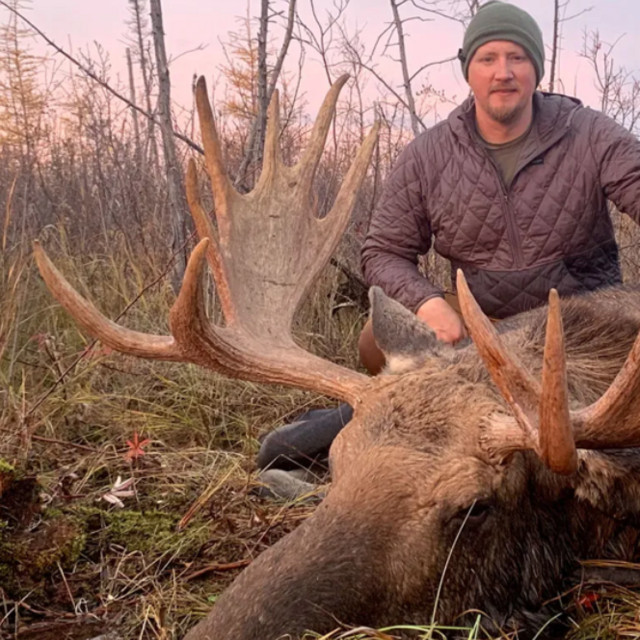
Tyler Freel is a hunting editor at Outdoor Life based in Fairbanks and the host of the Tundra Talk podcast. I drew a fly-in moose tag, and I can't stop thinking about it, so I called Tyler with a list of questions. We covered why suppressors beat muzzle brakes, how to get an old .30-06 threaded, why you should call from the same spot near camp instead of hiking two miles, how to take a moose apart without losing your mind, and what to do if someone else gets dropped off at your airstrip.
3 Key Moments
1. Nobody goes back
A suppressor takes a rifle from roughly 160 decibels down to about 130. That's the difference between a gunshot and a rock concert, which didn't mean much to me until Tyler explained it. Lower noise, no blast and less recoil keep you on target and let you spot your own shots, which matters when a mountain goat needs a second round.
"I don't know anybody that has got to spend some time shooting suppressors that ever wants to go back to shooting without them, or even hunting without them."
2. Call from camp
I kept hearing stories of people hiking two miles from camp only to have the moose walk right into it. Tyler calls from the same vantage point near camp every day, because bulls can come from a long way off and take their time. Sometimes there's one bedded down in the morning that came in overnight.
"I certainly would not hike two miles from my camp to try to kill one and have to carry him two miles."
3. Other hunters at the strip?
As for other hunters, there’s nothing you can do.
"Worrying about it's not going to do anything. It's almost never been an issue."
Transcript
Lund: So I've got a couple of questions about suppressors.
Freel: Yeah.
Lund: I was listening to the podcast with you and John Snow and, was it Natalie Krebs who was doing that one?
Freel: Yeah.
Lund: I had a couple of questions. I don't know if I missed it in there, but let's set this up. I drew a moose hunt, and say I wanted to put a suppressor on my .30-06. If I'm suppressing it, I'm decreasing the decibels, and it's also going to make it easier to shoot because it reduces the recoil. What's the main draw of getting a suppressor? Why would anybody want one?
Freel: The biggest thing is that it reduces sound dramatically and protects your ears, because even a single gunshot without hearing protection can cause somewhat measurable hearing loss. We still do it a lot in hunting, and I've done it many, many times, but it adds up. It also eliminates the blast. Especially if someone's used to a muzzle brake to cut down recoil, it's an enormous difference. So it reduces the noise, eliminates the blast and reduces felt recoil a lot, so the gun doesn't move and you can stay on target more easily. In a lot of cases you can spot your shots more easily, and it just helps you shoot more accurately in general. If you shoot your rifle a bunch, eliminating the blast and shock and noise makes shooting less stressful and more pleasant and enjoyable.
People commonly point to a rifle that kicks hard or hurts to shoot when we talk about recoil causing you to flinch or develop bad shooting habits. But really it's a lot of things. It's the movement of the gun, the blast and the noise, that sharp impulse that makes your body react. So it makes for a much more pleasant experience, and a lot of times a good suppressor certainly won't hurt your rifle's accuracy. Usually it helps, if anything.
Lund: There's a lot of game where you anticipate one good shot, but you know there's a chance you'll need a second, and getting reorganized and relocating can be a little hectic. With mountain goats down here, those things are stinking tough. You're shooting a .270, .30-06, .300, and sometimes they go down and sometimes they need that second one. So the second or even third shot is pretty important. I did a little research, but sometimes the numbers don't really tell us anything. You're reducing the decibels from about 160 to 130, and who knows what that is? The handy-dandy Google charts say a gunshot is around 160 and a rock concert is 130. So you're reducing a gunshot to a rock concert. Who cares? But for a lot of your shooting career you shot without a suppressor. How do you like shooting now? Because you shoot exclusively suppressed now, don't you?
Freel: Yeah. And that's probably the general guideline. Every suppressor is a little different, and even with the same suppressor, the sound level and tone, how you perceive it, will be different on different guns and in different surroundings and applications. But generally you'll reduce it from the 160 range down to about the 130 range. With a lot of them you still get the supersonic crack of the bullet with any hunting cartridge, and it might still sound a little sharp, but you're cutting a ton of it out. Everything from shooting off the bench to practicing to actually hunting is made easier and more pleasant. It's one of those things where it's hard to describe exactly what you like about it, but you know it when you experience it. And I don't know anybody who has spent some time shooting suppressors who ever wants to go back to shooting without them, or even hunting without them.
Lund: So a brake is pretty much just recoil reduction. A buddy of mine has a brake, and if you're to the left or right of him, all the sound is directed right into your ears, because that's where it all escapes out the side. Is the recoil reduction similar between a brake and a suppressor?
Freel: I'd say it depends on the suppressor and the brake. A rule of thumb is that you'll probably get a little better recoil reduction with a brake. But unless you're really trained up on it, I think that's canceled out by the overpressure wave, the blast wave, of the brake. We perceive it as sound directed at you, but it's really a pressure wave, and a lot of us have experienced how horribly unpleasant it is to be around someone shooting a brake. I'm interested to see what happens over the next years. Some brakes aren't as bad, but shooting a lot of brakes, I still feel like this can't be good for me. One particular brake I shot a little while back, and it wasn't even a big cartridge, literally made my eyes hurt when I shot it. And you experience that if you're off to the side, getting blasted with those pressure waves.
An Army PA told me the DOD recently adopted new training restrictions and guidelines around blast overpressure, even on certain weapons. They've found that repeated exposure to something like 4 psi pressure waves is linked to traumatic brain injury symptoms over time. I don't know exactly how that maps onto a hunting rifle brake, but brakes work by redirecting muzzle gases, and really effective brakes redirect them really well. So the more effective the brake, the more we might be subjecting ourselves to damage. And maybe I totally lost your original question.
Lund: No, that's exactly what I was talking about. That was great.
Freel: But generally cans will reduce recoil, maybe not quite as well as a brake. There are so many designs now, and the variety is growing exponentially. There are cans with end-cap brakes, which still direct gases in a way that reduces recoil even more, and flow-through-type cans with radial-pattern brakes. So it depends, but as a general rule of thumb, you won't get quite as much recoil reduction, but you get a lot.
Lund: If both of them reduce recoil, I'm assuming a brake is going to be less expensive. So if you're looking for a cheaper option, you might go with the brake. But then there's the potential for damage, and for just not having an enjoyable experience, so it'd probably be worth it to get the suppressor instead.
Freel: Yeah. I'm 100 percent sold on that. I may act like I present the positive sides of other options, but I'm pretty much sold on suppressors overall. There are some applications where a brake can be best. If you're shooting an NRL or PRS match with a heavy gun you really don't want to move at all, a brake can be fine. But for hunting, if I'm bothered by the recoil, I'd rather shoot a smaller cartridge and not use a brake. If a regular unprotected gunshot can damage your ears, well, I've had my bell rung a few times by brakes. For example, I've got a Ruger .338 Guide Gun. My .375 isn't threaded, but the Guide Gun comes with a brake on it, and trust me from experience, if you touch that thing off in the alders, your ears are going to be ringing for a minute. I've gone to using a can on that rifle, so at least it takes the edge off in case you have to fire it at real close quarters or in tight timber, and you're not hearing a high ringing tone for the next five days. I guess I could keep rambling.
Lund: If I did want to put a suppressor on my .30-06, do they make an adapter for it, or is the only real way to get it threaded? If there's an adapter without threading, it doesn't seem like that would be particularly safe. Is that an option, or should you not even think about anything except getting it threaded?
Freel: I'm not aware of any way, on general hunting rifles especially, to attach one without actually threading the barrel. Some rifles have muzzle devices, but those barrels are threaded too. So that's your one option.
Lund: And how do you go about doing that? I know people are pretty independent up here, but I can't imagine that's something you'd find on YouTube.
Freel: No, that's not going to be a DIY project. It's not like you go down to the hardware store and buy a tap and die set and handle it. It's got to be precision machine work. The biggest reason is that you need those threads to be precise and absolutely concentric. You've got to have the threads lined up so the bore through the suppressor is perfectly aligned with your barrel, or you're going to have big problems really quickly. A lot of local gunsmiths can do it. There are a few people here in Fairbanks who can.
If you're more remote, companies like Silencer Central are honestly probably the best way to buy a suppressor if you don't live near a Class 3 dealer. It takes quite a bit longer than, say, in Fairbanks, where we have a couple of dealers that use Silencer Shop, which is another company that facilitates the paperwork. If you can go into a shop that has that, it's much faster to get your suppressor in hand. Silencer Central is a slower process, but if you live remote, it's really convenient. They're one company that offers barrel threading. You pay a flat rate, they send you a shipping box for your rifle, you send it out, and when it's threaded they send it back. I know a few people who've used that service and have been really happy with it. And we're rapidly seeing new hunting rifles go that way. More of them are threaded from the factory than not now. But if you've got a hunting rifle you really like and have used forever, and you can get over the emotional stress of modifying it a little, I don't think most people would regret getting their muzzle threaded.
Lund: I can't imagine it would have adverse effects, because so many people do it. But what does it add as far as weight, balance and the overall feel of the rifle? They're not super heavy, but it is a little different. What have you noticed handling one in the field?
Freel: They can make things, sorry, it's my dumb dog. Hey, what are you doing? Come here. Quit that. Sorry. For normal, typical hunting rifles, we all grew up with 24-inch barrels, and adding a can can make them a little awkward to handle. It makes for an overall long package. I haven't noticed any adverse effects performance-wise from threading a muzzle or putting a suppressor on, as long as whoever threads it does it appropriately. There are standardized threads depending on your caliber and application. It just makes your rifle long.
In the last couple of years, a lot of really lightweight suppressors have come out. When I got my first one, coming up on probably 16 years ago, the thing weighed about two pounds and was nine inches long. It just wasn't practical to hang off the end of a hunting rifle, because it throws your balance off. In the past couple of years, a lot of suppressors are around or a little under 10 ounces, which even on a normal hunting rifle isn't bad. Another trend is that a lot of new hunting rifles are going to 20- or 22-inch barrels specifically to make a better-balanced package. And there are constantly new suppressors coming out. I know of one company doing a 3D-printed suppressor that reflexes back over your muzzle, so you only have about four inches out in front. Even on a 20- or 24-inch barrel, you wouldn't have a crazy long package, and you'd have better balance. That's probably the only really significant drawback, that they can make your rifle a lot longer and a little more unwieldy.
Lund: As far as care and travel, I'm assuming you'd take it off when you're hiking through the woods, or in transport on Alaska Airlines in a checked bag. Then when you're waiting for the moose to come in, you'd attach it, and then you'd clean it after use?
Freel: Not really, actually. Unless I need to take it off to fit in the case, I just travel with it on the gun. Now with the eForms, they email you digital copies of your paperwork. Technically you're supposed to have that with you when you have the suppressor anywhere, especially if you travel. But I just leave it on the gun and hike with it on the gun. You can get a little superstitious. I don't notice any big point-of-impact shifts when I take off and put on a suppressor on the same gun, but man, the fewer things you mess with, the better. I pick a gun with a little shorter barrel, and it's not uncomfortable to hike around with, so I just leave the can on.
As for cleaning, there are different schools of thought. Some people will tell you you never need to clean them. Centerfire rifle cans gradually accumulate carbon the more you shoot them, and there are different methods and tools for cleaning them, but you're basically soaking them in solvent to get some of the excess carbon out. With .22 rimfire cans, you do need to take them apart and clean them pretty frequently, because .22 rimfire is so dirty and you get a lot of unjacketed lead bullets, so lead and carbon build up in the baffles and eventually fill them up. But a can for your hunting rifle is pretty low maintenance. You'd almost never have to worry about cleaning it.
Lund: Gotcha. So let's pretend I have my .30-06 threaded. I got it back, I've shot it, and I've arrived at my fly-out moose area. I've asked you some questions before, but now that I've drawn something, I'm really getting into the details. Even though it's months away, I just can't stop thinking about it. It's going to consume my life, next to work and being a father.
Freel: Yep.
Lund: When we land at the strip, people talk about setting up camp and not going much farther than a couple of hundred yards. People talk about, oh, I hiked two miles from camp, and then of course the moose came right into camp. Is that the way to do it? Is it about not wanting to get your scent around? Is it because they're big animals and you don't want to have to pack one that far? What do you typically do?
Freel: Well, you take all the toys out there, so you have a lot of fun. We've kind of got it figured out in our little spot. We're not alone. There are other people around. But it depends. If you're getting flown out for moose, I'd find a spot to call near camp. Some areas you get flown into might have really good glassing, where you might actually see something. But I'd try to find the best vantage point or area near camp to call from, and I'd just call from there. If it's a spot where you can get up and see really well and maybe spot a bull to go after, even better. But we make a practice of calling from the same spot every day, because it can take moose a long time to come in. We've shown up in the morning, started calling, and there's a bull lying down that came in at some point during the night. They'll come to you, and they come from so far a lot of times that it doesn't seem productive to move a lot or waste energy moving. If you've got a suitable spot to call from, you're doing just as well calling from there. I certainly would not hike two miles from my camp to try to kill one and have to carry it two miles. Generally, if you can call one in over there, you can call one to camp, or to a reasonably close spot. If you're doing it the old-fashioned way on your back, it takes a long time to move them.
Lund: It's not my joke, but one of the first things I thought of when I drew the tag was you guys discussing whether the rut was late or early, so I had a chuckle about that. As far as calling things in, down here, when you call in a black-tailed deer, the first buck that shows up is probably not the big one. It's just the one that comes in fastest. Do you get larger groups, so you should be patient and wait for maybe a second one? Or does that not happen very often? What is calling during the rut like?
Freel: I think, like everything, it depends on the area and on how things are that year. There's not really any correlation, because of the way moose behave and because the density is low. When you get into September and they become responsive, they're moving so much that you're just getting the first moose that can hear you and wants to respond. There's not any rhyme or reason to it. Ultimately you just have to decide your standards or expectations. If you want to shoot a big one, you've got to pass up a small one that comes in first, and the big one may never come in. Or he might come in first. You never know. So the biggest thing is to decide what you want to shoot, or what you're okay with, and shoot the first one that comes in that meets your expectations. A lot of times it's not going to be a big one. But, like happened to me and my hunting partner this year, all of a sudden you look up and there's a 60-inch bull standing there 100 yards away.
Lund: Speaking of, there are a couple of deer that just walked into the yard. I'm sure my wife's going to go outside and scold them for trying to eat what she just planted.
Freel: Oh, man.
Lund: But down here, with the carrying capacity and the numbers, they're a lot more concentrated, especially during the rut around certain muskegs. I can't imagine there are going to be seven or eight bulls to pick through, so I'm definitely going to take the first one that's a good representation. It's an any-bull tag, and I only have about eight days, and everyone says you've got to go 10 to 14 days. So I'm hoping something comes in early that's a good representation, because I would hate to pass something up and then not see anything for the rest of the time. Obviously, like you said, it varies and you can never really tell, but people talk about 10 to 14 days. Is that just because it takes a while for them to come in? What's with the time?
Freel: It can certainly happen more quickly than that, but I think it's a good timeline. We've stayed out 14 days before. Where we're hunting now, we've pretty much always gotten chances where we could kill two bulls, but sometimes that's it. I think the timeline is reasonable just because they're such a low-density animal. You may get to a point in one calling session where you hear three or four bulls, and that's happened, but it takes persistence, and you're not going to call all those bulls in. I think that's probably what a lot of people have settled on, that you want to allow for that amount of persistence to have a good chance of getting at least one good opportunity. Sometimes it takes a lot less time than that, but as it averages out, that's probably why most people do it. We try to do 10 days, and we've pretty much always gotten chances at a couple of bulls within 10 days. But sometimes you get a bad stretch of weather for three or four days, windy, just not great for calling, and you might be doing well to get one opportunity in 10 days. It just depends.
Lund: What if something does go wrong? I've had black-tailed deer that just bump. They don't bolt, so you still have another chance. Same thing with mountain goats, where they get a little uneasy and feed away instead of getting totally out of the country. If you make a mistake or a moose winds you, obviously it depends, but can you stick with it and give it another chance? Should you wait? Or is it done for that one? If a stalk doesn't work out, what are the chances you get another shot?
Freel: Sometimes pretty good, depending on what they're doing. There are areas where there's a lot of moose traffic, relatively speaking, or places moose like to hang around, pinch points or around a lake, where you might see that moose again. Where we hunt, we've never really had that, at least that we know of. Sometimes we may be hearing the same bulls, but the moose are typically moving so much that if you can't reasonably go after them or make a follow-up stalk, it's not worth the effort or the emotional distress of worrying about it. You just keep doing your thing and trust that it's going to work, because it usually does. A lot of times it's a different bull. Where we are, there's just no reasonable way to pursue them. Some moose are kind of weird, though. If they're in an area they really don't want to leave, well, doing some assistant guiding back in the day, I watched bowhunters basically follow a moose around a big flat in a big circle for eight hours, and finally the moose got tired of walking away from them and they got a shot. So it depends. But if I had to make a call, if a bull runs off and there's not realistically an option for you, just keep calling and get the next one, hopefully.
Lund: Once you get one down, are there any tricks to butchering one that might be different from a bear, mountain goat or deer?
Freel: Moving them is the biggest pain in the butt. We can pretty much get a four-wheeler to the ones we kill, so that makes it simple. They usually die on their sides, but sometimes they die in a little hole. We've had that happen, where one dies in a muskeg pothole, and you're limited in your options. You just have to start skinning and taking it apart as it lies. But if you can, make sure you have some rope, and if you have two guys and can get it rolled on its back, we can also drag it away from the gut pile a few feet. I find it nice to pull the guts out first, because then they're easier to move around and manipulate. Pull the guts out, flop it on its side, take all the meat off one side, flip it over and take all the meat off the other. There are a lot of different ways to do it, but if you can't, you might just have to start skinning one side and taking meat off and cutting parts off until you're able to move it. Cutting the head off right off the bat makes them a lot easier to flip and roll, because a lot of times the head is down and the antlers get stuck in the tundra or whatever, or the antlers are a pain when you're trying to get one on its side or back, especially a big one. So one of the first things we try to do is position it, cut the head off, yank the guts out and then start working on the rest of the meat.
Lund: Are you using sturdy paracord, or some of the Dyneema stuff? What are you using for rope?
Freel: Usually a winch rope. But I wouldn't bother with anything super expensive. Some paracord would probably work great. I've used that to tie moose legs off to trees. It's helpful if you can get a moose rolled onto its back, tie off a leg, or even two, to trees or shrubs to hold it in position while you work on it.
Their guts are so big and heavy. A trick I've done for a long time, and it seems to work well, is from the old Frank Glaser book, where he talks about dealing with moose by himself. You split them, then skin back and cut away the flank on one side, whatever the convenient side is if there's any slope. Cut the flank away down toward the spine to open a pathway where you can pull the guts out and slide them off to the side in front of the hindquarter, instead of trying to pull them over the pelvis. That works pretty well. If you're really limited on weight, a hand bow saw could be handy. We just use a Sawzall. Splitting the sternum with a saw makes it a lot easier. You can open up the guts, cut through the viscera and use your Sawzall to rip the sternum in half, then use a knife to start at the trachea and pull it all the way back down. You want to make sure to get as much of the trachea out of the neck as you can, because that will spoil pretty quickly.
Lund: What about knives? Do you go fixed blade, replaceable blades, a couple of each?
Freel: I usually just have a kit with two or three different fixed-blade knives for dealing with moose, and whatever sharpening stone or setup you use. That seems to work pretty well. Usually one really good sharp knife with a couple of touch-ups can get a moose gutted and taken apart nicely.
Lund: Then in camp, when you're cooking it, what's your preferred method?
Freel: Oh, I don't know, man, probably...
Lund: Go ahead. We've just got a deer out eating the tulips right now. My wife has her earphones in, so she can't hear, but she just saw. Now she's going to chase it. We might have some venison for dinner. Sorry, go ahead.
Freel: No, probably just fried in butter with salt and pepper. I like to bring my backstraps and all the meat out on the bone, so I don't like to cut any off. But some of it we just fry up in butter with salt and pepper.
Lund: I'm thinking about everything to bring. It might be a little presumptuous to bring stuff ready to cook, but it's very little weight. So I'll bring some spices and some butter, to be able to enjoy some if we happen to get something. I'm pretty excited about the prospects of that.
Freel: If you're not severely restricted on weight, it's nice to bring some real food anyway, and that's just basic stuff you'd cook anything with. So it's worth having in camp.
Lund: Do you have a separate cooking area and sleeping area? Or, being near an airstrip or wherever you camp, are the bears just used to people in that area?
Freel: I don't know. We just cook in our tent vestibule.
Lund: That's the cook tent. That's not the official recommended thing to do, but it's what you have to do based on your assessment of the risks, right?
Freel: We've actually only seen one bear in moose camp, and I'm pretty sure it was just wandering through. It was two or three years ago, in the middle of the day. We'd called in the morning, had breakfast and were taking a nap, and I got up to walk out and brush my teeth. Back behind the tent I saw a black bear's back walking through the brush. I ran back to the tent and grabbed a rifle, and by the time I got back over there, it had taken off. We definitely didn't want to be dealing with a problem bear, but we didn't shoot it. It's just like anything. You want to be careful. You don't want garbage strewn around. We bag our scraps. We usually pitch our coffee grounds out, but we try to have a relatively clean camp. You can certainly have bear issues in certain areas, but I think most of the time it's not as big an issue as people make it out to be.
Lund: When I think about problem bears, I think about bears that have been at least somewhat habituated. Look at some of the Forest Service cabins around here on the mainland, where people throw their scraps off the front porch. Well, yeah, that's why there are stinking brown bears around. You're cooking crab and shrimp and throwing the shells right off the deck. Of course the brown bears are going to be around. If they don't have to be around, they're not going to be. So common sense and being smart from the start should help prevent those things.
Freel: For sure. And you want to find a spot to hang your meat. Ours is 100 yards from camp, and we check on it frequently. Unless a bear stumbles onto it, it's not like sharks smelling a drop of blood from a mile away and coming running. Meat that's well taken care of, you can certainly smell it, but it's not like it stinks. And with the gut pile, since our goal is to kill two moose from the same spot, we drag the hide over top of the gut pile. It usually gets cold at night, so it keeps it cooler and insulated during the day, keeps any scent or decomposition somewhat limited, and the birds can't get to it, so you don't have ravens squawking all the time.
Lund: That makes sense.
Freel: Literally, my bull this year, I shot him walking 30 yards from the other bull's gut pile a few days later.
Lund: Nice.
Freel: Yeah, several times we've had that. Actually, that bull too, he was probably only 30 or 40 yards from the first gut pile. So those are just a couple of things we do to try to mitigate scent that might attract bears.
Lund: In closing here, anything else about suppressors or moose, or etiquette? Down here, there are only so many lakes people can fly into, so the chances of having it to yourself are pretty solid, but at times people are going to fly into the same lake. There are limited airstrips up there. If you get flown in somewhere someone else is, what happens? Do you meet in the middle and play rock-paper-scissors? How does that work?
Freel: I haven't really dealt with that for moose myself. It's a tough one, because if you're both calling from the same airstrip, you're just working against each other. It's not productive, and it's not like you can say, we'll walk this way and you walk that way, because you're all calling the same moose. So I'd have a serious talk with the air taxi about putting me somewhere else if that was the case.
Lund: I'll be thinking about that nonstop, too. Just hoping, A, that it's going to be clear and open so we can get there, and B, that there's no one else there.
Freel: Depending on the place and everything, it might be worth talking with them about what happens if that happens, backup spots and that kind of thing. Even if you could get a few miles away, if they've got other spots within a reasonable distance, just to get some space from other people. You don't necessarily have to be five miles from the nearest person to be successful by any means. But hunting out of the same airstrip for moose is probably going to be kind of contentious.
Lund: That's going to be the nightmare for the next six months, or however long it is.
Freel: Well, if there's any advice I'd give from over the years, from sheep hunting: I used to really get bent out of shape worrying about who we'd run into here or there. And worrying about it isn't going to do anything. Most of the time, it's almost never been an issue. Almost never.
Lund: Nice. Hopefully that's the case.
Freel: And suppressors, I think they're a good buy. It depends on what you want and your budget. There are a lot of really good, pretty lightweight suppressors for about a thousand bucks. Not including the tax stamp, you can get into them for about 600 bucks too, and for a lot of normal hunting purposes those are totally fine, but they're going to be a little heavier. If you were just going to buy one hunting rifle suppressor, something like the KGM R30K is going to be really hard to beat. Just good, durable, recoil-reducing suppressors, right about a thousand bucks.
Lund: Cool. So if people want to listen to the in-depth, total nerd-out you went on, that was on the Outdoor Life podcast. Was that the latest one, or a couple of weeks ago?
Freel: Last week, I think.
Lund: "Suppressors Are the New Normal." That was April 2nd.
Freel: Yeah. That was from our gun test. We went pretty in-depth and talked about a lot of the aspects of suppressors and where they're at with hunters now.
Lund: Nice. And then Tundra Talk is your podcast. I think that's about it. Anything else you need to pitch or say to the people?
Freel: I don't think so. Thanks for listening. Hopefully someone gets a couple of useful tidbits. That's worth it to me.
Lund: Well, I did. That's the main thing. I'm just in this for myself on this one.
Freel: Well, nice, man. I'll welcome you to the dark side.
Lund: Hopefully. I've been talking about it in front of my wife, so I wonder if she thinks something's on the way. But there isn't.
Freel: Cool. Thanks, man. I appreciate it.
Lund: Yeah, no problem. See you.