

Mark Kenyon on Wired to Hunt, Alaska and Fighting for Wild Places
About Mark Kenyon
Mark Kenyon is the founder of Wired to Hunt, which he started as a homesick college intern in Manhattan in 2008. He kept it going through four years at Google before going full time and eventually merging it into MeatEater, where he hosts the Wired to Hunt podcast and makes films. He is also the author of That Wild Country, about America's public lands, and is working on a book about the biodiversity crisis and what hunters and anglers can do about it. We talk about his trip to Southeast Alaska and Bristol Bay, why Alaska still has what the Lower 48 lost, and raising his boys to be comfortable being uncomfortable.
3 Key Moments
1. Two north stars
Mark calls himself analytical. Every big jump came with pros-and-cons lists and contingency plans. But two rules decided it: follow curiosity, excitement and passion, and when one fork in the road scares you more than the other, that's usually the one to take.
"If it will force me to get outside of my comfort zone and will force me to grow and change, I've found now that that's usually the way that I should go."
2. Fishing is the yin to the hunting yang
I asked how he keeps his passion from becoming only a product, since I have the same problem when I'm thinking about column angles while the deer aren't cooperating. Mark writes down three specific things he's grateful for every morning, chases side interests on the podcast when it gets stale, and keeps fishing almost entirely off the clock.
"Fishing is just pure joy, pure filling my cup. And that is the yin to my hunting yang."
3. What the Lower 48 lost
Mark's trip to Alaska included a Sitka blacktail hunt in Southeast for a MeatEater film and rainbow fishing on the Kvichak for his next book. Watching caribou stream past gave him the feeling he'd only imagined about Lewis and Clark and the bison herds. It also made Pebble Mine feel personal.
"What we have in Alaska is what we have mostly lost in the Lower 48. So let's not make those same mistakes again."
Transcript
Lund: Mark Kenyon, welcome to the podcast.
Kenyon: Hey, thank you for having me.
Lund: Because I have to head to school in a little bit, I want to ask about your senior year of high school, your English class. Where are you sitting? What are you doing? And what was your grade?
Kenyon: Hmm, geez. Wow. The details. The details will be a little iffy, but if I remember right, I was usually sitting somewhere in the front half of the class in English, because I liked that topic. I sort of enjoyed writing, and I definitely enjoyed reading, and my grade would have been pretty good. I think I was getting A's in English. Were you curious about what I was generally doing and thinking at that time, or just the grade and where I was sitting?
Lund: Well, sometimes people are doodling about something else and planning their life outside of class. Were you an attentive student? Did you pay attention and answer questions? Or were you showing up late with McDonald's?
Kenyon: Again, I was pretty decent in English, so I was showing up on time. I might have been thinking a little about the future, but if it was an engaging part of the class, I'd be paying attention. I loved reading even back then, but I definitely remember not liking the stuff assigned in English class as much as the stuff I would have picked out myself. I would have been interested in books about climbing mountains or going on some big adventure somewhere like Alaska, or hunting or fishing or sports. Those types of books would have been really engaging. I was not excited to be reading and talking about Jane Eyre or Of Mice and Men or something like that. So I definitely would have been daydreaming about wishing I was doing or reading something else.
Lund: I can't imagine that when someone asked what you were going to do after graduation, you said, "Oh, I'm going to go to Michigan State, then start a website in 2008, then get a job at Google, and then leave my Google job to pursue my website." That was probably not the answer.
Kenyon: It definitely was not. I had no idea those things would transpire. If you'd told me back then that I'd be doing what I'm doing now, I would have been thrilled. It would have sounded great. But I don't think any of these things seemed within the realm of possibility. At that point in my life, I thought I was probably going to do something related to business, but I had no clue what that would look like. I did not have a clear sense of mission or purpose or really any direction. So anyone at that stage now shouldn't feel bad if that's how they feel. I think it's pretty common, when you're a senior in high school, to start getting this pressure to know what you're supposed to do. You've got to make some choices about whether you're going to college, and if so, where, and what you're going to do. Or if you're not going to college, what kind of job you're going to get. I don't think anyone really has it figured out right out of the gate. Very few, at least.
Lund: I had a student last year, and I was asking what their dreams were. I said it doesn't matter if you have a dream or not, just move forward in some regard, and if something stands out as a pursuit, that's great. One kid said he didn't have a dream, he just wanted to be a lineman. I said, dude, you have a career you want to pursue. That's great. And he said he wanted to go down to Idaho to do it. I said, phenomenal elk hunting. You're setting yourself up very well to have a very happy, content life if you work hard.
So as your journey was changing and evolving, what were some of the key moments? Why did you start the website in college? And later you got the job at Google, but then you went back to the website. What motivated those decisions?
Kenyon: The foundation that has led to where I am now is that I was raised in a family that valued the outdoors. If we were ever going to do something special, go on vacation, go somewhere, it was usually something outdoor-related. We were going up to northern Michigan to our cabin to hunt or fish or scout. We were heading somewhere to go camping. We were going to my mom's uncle's place in the Adirondack Mountains of New York to go canoeing and camping and hiking. From a very early age, I was steeped in a love for the outdoors. That has always been my thing.
But as I went through school, there was also some interest in business and marketing and advertising, and when I was heading off to college, that seemed to make sense to pursue. I never imagined the outdoors was a place you could make a career. So I got a business degree. The website came about the summer before my senior year of college. I had taken an internship in New York City with an advertising and PR agency. I was living in Manhattan, right in the middle of the concrete jungle, doing this internship that was supposed to be kind of the dream job. And I was miserable. I was stuck in the city and couldn't get outside to do the things I loved. I was surrounded by noise and chaos and concrete, missing the outdoors.
My job was working with websites and bloggers, people who had websites and blogs about products my clients wanted to get out to the masses. I'd reach out to a blogger or writer and try to encourage them to write about Reebok shoes or Tommy Hilfiger or whatever it was. That's when I realized there were people out there with a passion for something, maybe sneakers, maybe fashion, maybe sports, and they were writing about it, and people were sending them free stuff and paying them to do it. There was this whole world beginning online around passions and projects and activities. And I thought, why couldn't I start something like that about my passion and my love? That's when I decided to start a website called Wired to Hunt. It was basically a way to scratch the itch. I couldn't go out deer hunting. I couldn't get outside hiking and scouting and doing all that kind of stuff, but I could write about it. So in the summer of 2008, I started this website, and it got me through that summer in Manhattan. I'd come home at night and work on it, think back on all my memories and write these stories, and it helped me feel like I was doing those things.
That was the first big inflection point. Fast-forward a year, and I took a full-time job after college with Google, as you mentioned. They sent me out to their headquarters in California, just outside San Francisco. Again, I'm feeling the same way. I'm stuck in the city. I'm around people who aren't interested in the same things I'm interested in. I'm missing the outdoors. And I returned to Wired to Hunt as a way to scratch that itch. But it went from being a way to satiate my desires to actually being a career. In probably my first month at Google, I read a book called Crush It by Gary Vaynerchuk. The subtitle is "Cash In on Your Passion." It was all about building a career around what you're passionate about, using digital tools and the digital economy. And I realized, wow, I could take this website I built as a fun thing and turn it into a real career opportunity if I really doubled down and took it seriously.
That was the fall of 2009. That's when I got serious about learning how to build an online brand, use online marketing tools, write well, and use social media and all these different platforms to share my message and my stories. From that point on, it was work, work, work. I'd do the full-time day job at Google, then come home and work all night on Wired to Hunt. I'd get up early the next morning and work on it more. I'd work on it during my lunch break. But it didn't feel like work, because I was so excited and so passionate about it. That's been the story ever since. I worked on Wired to Hunt for four years while working at Google. After four years, I was able to quit Google and go full time in the outdoor world, and I did that on my own for another four years. Then I joined MeatEater and merged Wired to Hunt with the larger MeatEater network, and it's been, I think, eight years doing that.
Lund: As you were deciding whether to make these big jumps, what was that conversation like? Did you make a Venn diagram, a pros-and-cons list? Some people just jump at opportunities, burn the ships. Are you more methodical?
Kenyon: Definitely on the methodical side. I'm an analytical guy. There were pros-and-cons lists, thinking through best-case and worst-case scenarios, developing safety nets and contingency plans, thinking through long-term strategies, all of that. But when I made these big decisions, there were a couple of north stars. The number one north star was following my curiosity, excitement and passion. My grandpa was one of the first people to instill this in me, and then my father: if you're truly passionate and excited about something, if you love it, it won't feel like work. It will feel like something you genuinely want to do. If you're genuinely excited about your work, you're going to excel at it and work really hard at it, and if you do those things, everything else will take care of itself. So when I made decisions that let me follow that curiosity, excitement and passion, it always led me in the right direction. When I have that natural energy source, I'll work all night and all day, because I'm genuinely excited. When there's a fire in your belly, it's really hard not to do good work.
The second thing, with many of these fork-in-the-road decisions, is that I've learned that if one of the two options is a little scarier, if I feel apprehension and worry about it, if it will force me to get outside my comfort zone and grow and change, I've found that's usually the way I should go. The decision that forces you into a new area, forces you to take that next step outside of the comfortable, has been a clue to me that that's probably where I should head. And that has served me well. I've tried to pursue things I'm excited about, and things with an important cause or mission behind them. That's guided me in these later stages of my career, as I've moved from just being able to do something I like to wanting to work on things that I think make a difference.
Lund: People talk about careers and say if it's something you love to do, you'll never work a day in your life. That's a really great ethos, but there have to be days when it's a slog. How do you get through the slog? I look back at my teaching career, and you have that youthful exuberance at first. Then after a while, it's not burnout, because you still feel a purpose, but some days are easier to get through than others. There are things you have to deal with now where you think, man, this is all the extra stuff. I'd like to get back to the foundational days when I was staying up late because it was the actual thing. How do you combat the, I don't want to say staleness, because it seems like you're super happy and loving it, but the times when it's not as easy or not what you first expected?
Kenyon: You're 100 percent right. There are times like that with any job, because it's a job, and some days even the thing you originally loved begins to feel like work, because of the obligations and pressures of work placed on it. And there are parts of jobs that are just inherently not as much fun, the administrative stuff, the boxes you have to check, the people who are sometimes hard to get along with. So yes, that's all true, even for my job, which in many ways is a dream job. I absolutely have times when I'm burned out, frustrated, not enjoying it.
There are a couple of things I do. Number one, sometimes you just have to grit your teeth and bear it, because that's part of life. But when I find myself spiraling into negativity, I try to pinch myself and step back and have some perspective, and remember where I am and how fortunate the circumstances are. Even the bad days of what I do are so much better than the best days of what I used to be doing. I have a daily practice that helps with this a lot. It's really simple, and maybe it's cheesy, but every morning I write down three things I'm grateful for. Specific things. Not "my health," but a very specific thing that happened yesterday or this morning. In the context of work, that's very important, because you can get so caught up in the everyday drudgery that you lose perspective about how genuinely good certain things are. That gratitude practice gives me a moment to pause and remember the good stuff.
Second, I try to remember that you're never, or hopefully never, stuck in any one lane forever. Sometimes I'll find that what used to do it for me doesn't quite do it anymore, or not 100 percent. So when I'm feeling that burnout or drudgery, or losing the passion, I try to uncover where the flicker still is and feed that. For example, I do a podcast every week. I've been doing it for more than 10 years, generally about the same topic every week, and sometimes I'm running out of new areas to explore without it becoming the same old, same old. So to rekindle some excitement, I might say, we're going to go in a totally different direction for a couple of weeks and dive into this other thing I'm genuinely interested in, which maybe doesn't seem related to our usual topic, but actually has some very surprising connection points. Letting myself go off the reservation and try new things reignites some of that excitement. Giving yourself permission to try new things and chase those butterflies of interest that you think don't necessarily belong can go a long way.
Lund: Monetizing the passion can be a tricky thing, because it ceases to be what it was. I have a bunch of friends who say I should guide during the summer. As a teacher, I have the time off. Well, if I'm guiding, then I'm not fishing. I like to fish. I don't want to teach people about fishing, because the rest of my career is teaching people. I also do freelance writing, and there are times when I'm out there and I don't want to write the story that's happening. I'm already thinking about the column and the angles, and I'm not enjoying the experience as much as I should, because I want to write a successful article and it's not looking like the deer are going to cooperate. Do you have hunts that are off the books? This one I'm not going to write about, it's not going to be filmed, it's just me? Do you have those opportunities, so not everything is a marketable experience?
Kenyon: I think that's critical. That's the trick to keeping it fun, because the work side of it completely changes the experience. So yes, I try to increasingly find times to have hunts that are just a for-me experience, because that's what refuels you. That's what puts gas back in the tank, so you still enjoy it and can do your job when it is that time. Most of my work-related outdoor activities are on the hunting side, so fishing, which I love just as much, doesn't have nearly the work obligations. Fishing is the place I go to refuel. Hunting season feels like work a little more. I still love it, but there are all the work pressures. Fishing is just pure joy, pure filling my cup. It's the yin to my hunting yang. It refills the tank and gives me a lot of energy and excitement, and there are no strings and no obligations attached. That's been really important for me. So yes, I absolutely agree. If you're going to build a career around your passion, that's great. I'm very glad I did it. Even though there are times it feels like work, that's okay. It's still way better than it would have been otherwise. But preserving some of it just for you, creating those spaces and opportunities to get back in touch with why you got into this in the first place, is so important.
Lund: That's a perfect segue to your summer adventures in Alaska. I know you'd been here before, but was this your first king salmon? And then you also went to Bristol Bay. Those are some bucket-list moments.
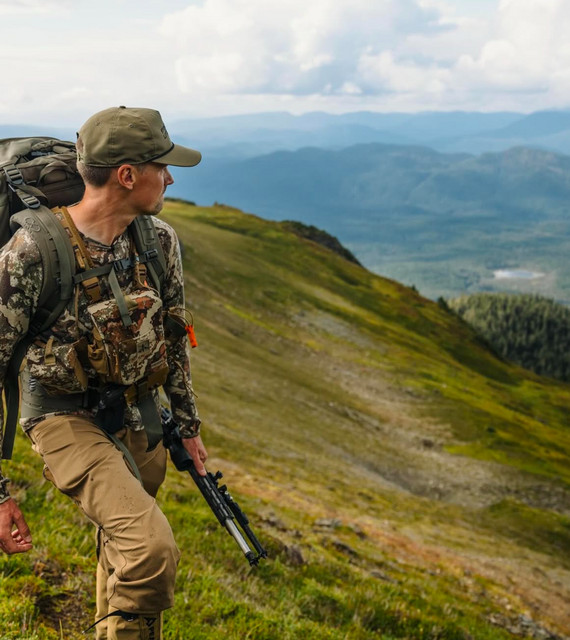
Kenyon: Like you said, it was my second visit to Alaska, but absolutely an incredible trip. I didn't catch a king. I caught some cohos, some big silvers. But it was my first time fishing in Alaska, and it was everything you could dream of. I'm sure it's different living there, but as someone from down south, you dream of Alaska all your life, and to finally get up there and see these things with your own eyes is spectacular. I did a deer hunt in Southeast Alaska. That was incredible. I got up into some alpine territory, did some serious hiking and climbing, and saw deer doing their thing, unbothered by people. Just an incredible setting and hunt, and it was successful. I tagged a nice black-tailed buck. I got to do some trolling around Juneau and caught some big silvers, saw some humpback whales, hiked up to a glacier. That was spectacular. Then for the second week, I went up toward Bristol Bay and fished for rainbows on the Kvichak River, learned a lot about what's happening with the proposed Pebble Mine, and really sank my teeth into an incredible watershed. I caught all sorts of rainbows, a few salmon and a bunch of big grayling, and just loved it. I'm hoping to go back this year for a different project. Alaska residents probably don't like to hear about Southerners wanting to come up more and more, because I know you want to keep it to yourselves, but you're going to have a hard time getting rid of me. I'm going to get up there as much as I possibly can.
Lund: I think it really depends on the story people tell. Ketchikan is very dependent on tourists. We had 1.5 or 1.8 million people off cruise ships this last year. Without logging, without mining, without the other industries that have gone, there's really nothing else as far as infrastructure goes, so we need that revenue. It's a tough thing. We're reliant on them. But it's a lot of fun to see people come up and really appreciate it. You have people who come up expecting 50-pound king salmon, and they're rude and entitled. But there are also so many people who are so excited to see a humpback whale, or even eagles. People are just fascinated by eagles, and I think, man, I should be more fascinated by eagles. I get to see them all the time. I should appreciate that. So when people come up and tell the story of wonder, and they love it and want to preserve it and use it responsibly, I think that's really beneficial. But there are times when you think, man, this is getting a little crowded.
That was always one of the temptations I had as a writer. I could write about where to fish and how to fish, but then I thought, man, this is my home river. I remember growing up, there were people who would come to the river and push us off the spot, because they'd spent all the money to come up here, and I'm just a little 12-year-old kid, and they want to catch the fish because they paid. So I have some of those memories, but I don't want to resent people for it. You can't paint every tourist or every fisherman as that person. That person was a jerk. People who come up and tell great stories and care about it and want to protect it are the people Alaskans often really, really like. So what was the project? Was it just for fun? What are you working on?
Kenyon: Two projects, actually. One is a film I'm working on for MeatEater that will be coming out sometime this year, and that's what the black-tailed deer hunt was for. It's going to be the story of this black-tailed deer hunt and a larger ecological story about Sitka black-tailed deer, as well as other species, moving into parts of Alaska, why that's happening, how it's happening and what it means for the future. That's a larger project that will be really interesting, and I'm excited to start sharing it with the world. That was part one of the trip.
The second part of the trip, involving the salmon and the trout and the fishing and Pebble Mine, is for a book I'm working on that explores the biodiversity crisis, basically the threats to fish and wildlife across the world, and specifically in America, and the opportunities hunters and anglers have to be part of the solution. I've been traveling the country meeting with hunters and anglers, conservationists, researchers and scientists to understand what's happening. Why are so many fish and wildlife species struggling or threatened in various ways? And what can we do to stop the bleeding and protect and conserve these critters and these wild places? That's what that part was.
Lund: Pebble Mine is super interesting. I'm on my third bumper sticker, because it just never goes away. It seems like it's dead, but it never goes away. I've never met an Alaskan who is for it. I've met some people who are okay with the Ambler Road, because it's an access road to an area most Alaskans can't get to anyway. Some people look at the Dalton Highway and think, well, the Haul Road was just meant as a service road for the pipeline, and now that it's open to the public, you can access an area of Alaska you otherwise couldn't. Not everybody can afford fly-outs. So people are okay with drilling, and maybe okay with the Ambler Road. Other people say no to the Ambler Road, because there are going to be 2,000 or however many culverts, it's going to cross six or nine major rivers, and it's going to cut across the lower portion of the Brooks Range, so the amount of habitat that will be impacted, if not ruined, is substantial. Whereas Bristol Bay is so absolutely, clearly absurd and destructive. I'm still terrified, even though it always looks like it's about dead. So what was in the back of your head while you were fishing? Was it, how can people be so greedy? There's also the technological piece. The more technology we use and the more electricity we need, and our use is so high, there's demand for all these minerals, and we have to get them from somewhere. It's certainly not easy.
Kenyon: A couple of things were on my mind throughout the trip. Number one, I was constantly struck by the realization that what you have still in Alaska, or what we have, you can say we, we're Americans, is what we have mostly lost in the Lower 48. I find myself all the time in the Lower 48, traveling across the Great Plains or hiking in the mountains, thinking, man, this is great, but can you imagine what it must have been like when Lewis and Clark first struck across this in the early 1800s, with herds of buffalo streaming across the plains in the tens of thousands or millions? I imagine that all the time. Then I get to be up in Alaska in the mountains, watching thousands and thousands of caribou stream past in front of me, and I remind myself, I am living that right now. This is what it used to be like in the Lower 48, but we still have it in Alaska. There's so much still intact that's worth protecting, that we've already lost in the Lower 48. So let's not make those same mistakes again. What we used to have is still there in Alaska. We can protect that. It's incredible that we still have that now in 2024. It seems even more important now than ever to protect these last remnants of wild we have in the world. It's an increasingly rare resource, so precious that it would be an absolute tragedy to lose it.
To your point, there are ever-growing demands for resources, and we need them for modern life. But I feel like these wild resources are just as important as gold or oil or timber, and golly, we're not going to get them back once we lose them. So there has to be some value placed on that. A lot of it comes down to bringing attention to it, helping people understand the value and connecting people with those things. While I was up there, I was thinking, this incredible thing worth fighting for is still there. And there was also some worry, like you mentioned. The demand for these things, our insatiable desire as a species for more, more, more, is scary. You can become a little nihilistic when you look at the trend of the last 200 or 300 years. We're biting away at this stuff more and more, and it's been really hard to slow down. Sometimes I get negative about it.
But then I'm reminded that every once in a while we catch ourselves, pause and fix things. What we did in the late 1800s and early 1900s is a really good example of what's still possible. We were flooding across the United States and destroying basically everything in our path. So many wildlife species nearly went extinct. We almost lost buffalo, elk, deer, bears. Everything was brought almost to a screeching halt. And we tapped the brakes and said, whoa, we've gone too far. We didn't realize we could make an impact this way, but we really can. We need to change our ways and find ways to do this differently, so that yes, we can grow as a country and a civilization, but in a way that preserves some wild places and other species alongside us. That changed the trajectory of our relationship with wild animals and wild places. That's the only reason we still have flourishing populations of elk and white-tailed deer in the Lower 48, grizzly bears are making a comeback, there are wolves again, and mountain lions are spreading across the country again. In many ways, we've proven we can right our wrongs, moderate a little and take a different path. So I'm hopeful we can do that again, as we near another of these inflection points where a lot of wild places and wild animals are trending down and the pressures are mounting. I have faith in us as a people that we can care about something more than just ourselves.
Being out there in Alaska on this trip, I was reminded how powerful these places and animals are. If you can connect people with these landscapes, they can't help but feel something really deep, a very primal connection, and I think that can give a person a reason to want to moderate, to work, to advocate, to fight for these things. One of my jobs, I think, is helping bridge those gaps, helping people understand that we still have this amazing place and resource and wild animals that deserve our care and respect. And I believe we can do it.
Lund: That's kind of how you closed your book, That Wild Country. You were in the Yukon-Charley for the caribou hunt, and I think your firstborn was pretty young when you took that trip. It flipped a switch, that it's not just about preserving it for you, but for the next generation. I'm feeling that, too. My daughter is almost four months old, and I wonder what she's going to have. What will be left? What experiences will she have? We're going to take her out on hunts, but when you're one or two years old, you don't really remember it. There will be pictures, but what will she be able to experience?
Kenyon: That has been a huge motivator for me since having kids. My boys turn seven and five in a couple of weeks. It's crazy how fast that's happened. That's what gets me more fired up than anything, to keep working on these things and do anything I can to protect these opportunities, these places, these animals. The wild places and animals on this earth have given me so much. So many of the greatest experiences of my life have come from these wild places, and I so badly want those opportunities to be there for my boys. I feel a strong obligation to give back and make sure that's available not just for my own kids but for other generations too. Being out there is so powerful, whether you hunt or fish or backpack or climb or hike or whatever it is. That's what it's all about. And we've got to fight for it, because if those of us who actually get out there don't fight for it, nobody else will. Folks who aren't connected to these things the way we are have no idea. So it's on us to do the heavy lifting to make sure this stuff is around for the future.
So yes, I ended That Wild Country very much with that mindset. That book was really focused on the land, on the public lands we have. This next book is very much a continuation, but it's focused on the animals living on that land, because you don't have one without the other. Imagine if we had all these incredible public lands but no wildlife on them. How lonely would that be? How different would those experiences be? And vice versa. If you've got a whole bunch of critters, but we're destroying and selling off the lands they need to survive, we won't have those animals for very much longer. Those two things together are the foundation of what we need as a human species to thrive. We have to have fellow travelers on this earth with us, and we have to maintain some wild places and healthy ecosystems for us to thrive too. They provide ecosystem services that give us the water we need to drink and the clean air we need to live, and so much more. So in some ways it's a selfish endeavor. Protecting these animals and places will help us in the long run, too. This isn't just an altruistic thing for nature lovers. If you live in a city and want to keep being healthy and happy and able to flourish, you need this stuff, too.
Lund: The first time you took your boys out fishing, hunting, hiking or whatever, were you just like, please like this, please like this, please have a good experience, so you don't want to be inside on your phone or games? Your kids probably don't have phones at seven years old.
Kenyon: They don't have phones. Fortunately, they were doing this stuff before they had a choice about whether they liked it. I started taking them out from the moment they were a couple of weeks old. My firstborn was living in a camper for months at a time when he was four months old. We lived alongside the Yellowstone River in my renovated camper for two months his first summer and another two months his second summer. They've been camping, hiking, fishing and hunting every year of their lives since the very beginning, so that has built in for them that this is just the way of life.
That said, from the very beginning and still to this day, I try to make sure these are experiences they're going to enjoy. I try to prioritize their experience and not get caught up in my own personal goals on these trips, which is sometimes easy to do. But I try to balance the two sides. On one side, I want them having fun and enjoying it, for all the reasons you mentioned. On the flip side, I've found that the outdoors is an incredible testing ground and learning opportunity, kind of a forge for you as a person. Going through some tough times in the outdoors can really help build inner strength, toughness, resourcefulness, all of those qualities. So I've tried to keep it fun while making sure they experience some tough stuff too, because I think that's part of necessary growth. Becoming comfortable with being uncomfortable is a really important quality that the outdoors teaches very well. I'm constantly trying to walk that line with the boys, and I think we've been able to do it. There have been lots of opportunities for fun, and lots where, man, this is tough, but we're going to make the best of it and make it fun. We're backpacking, and we thought it was going to be a summer camping trip, and instead it's 25 degrees and blowing snow. But this is fun in its own way. Let's make it an adventure. So it's been good for many reasons.
Lund: You had a whole bunch of good quotables in there. I don't know if you have any closing thoughts to add, or if you just want to give the pitch for your first book and where people can find you.
Kenyon: There's a line Edward Abbey wrote. I don't remember the specifics, but the general sentiment is a really important one, something I try to keep in mind all the time with the topics we've been discussing, the many threats to public lands, wild places and wildlife. He says you've got to be an advocate. You have to fight for these things, stand up for them and speak out for them. But on the flip side, you also need to get out there and live it and love it and immerse yourself in the wilderness and the wild places wholeheartedly. You have to give yourself to these places and soak up every little bit, because that's the only way to have the fire and passion to keep fighting for them. I wish I had the whole quote in front of me, because I'd read it to you. It's terrific. But he basically goes on this diatribe about how, yes, you've got to fight, but then live it, love it, soak it up and get out there, because if for no other reason, you will outlive the bastards. All the folks trying to destroy these places, if you can get out there and love them enough and enjoy them enough, jump into the lakes and squeeze every ounce out of this wild life, you'll make a difference and you'll outlive those suckers. And hopefully we'll have these places for many more years to come.
If anyone wants to read the first book, That Wild Country, I think we have a few autographed copies still available on the MeatEater website, themeateater.com. Otherwise you can pick up a standard hardcover or softcover on Amazon. The podcast is the Wired to Hunt podcast, available anywhere podcasts are. And all of my films and TV shows are on the MeatEater YouTube channel now. That's where this black-tailed deer hunt film will be, probably sometime in 2025, as well as plenty more. I appreciate anyone checking that out.
Lund: Awesome. Thanks for being on here, man. I appreciate it.
Kenyon: Thank you, Jeff.